
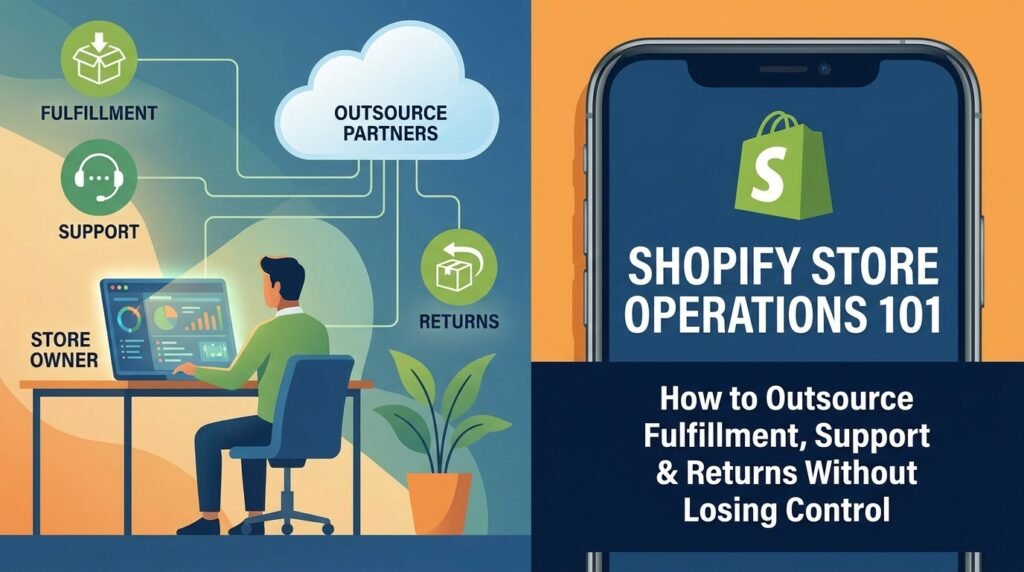
If you run a Shopify store, you already know the truth nobody puts on the landing page: growing a store and running a store are two completely different jobs. One requires vision, product instinct, and marketing creativity. The other requires you to answer the same customer email fifteen times a day, chase a supplier about a delayed shipment, and process a return at 11 p.m. because that’s the only quiet hour you have left.
Most store owners don’t burn out because their business is failing. They burn out because they’re doing three full-time jobs at once — founder, customer service rep, and operations manager — and only one of those jobs actually grows the business.
This is where outsourcing store operations comes in. Done right, it doesn’t mean losing control of your brand. It means finally having the bandwidth to build it.
What “Store Operations” Actually Covers
When people hear “outsourcing,” they often picture a vague, risky handoff of their entire business to a stranger. In reality, Shopify store operations breaks down into a handful of concrete, repeatable workflows:
- Order fulfillment management — tracking orders from checkout to delivery, coordinating with suppliers, flagging delays before customers notice them
- Customer support and inquiries — pre-sale questions, shipping updates, order issues, live chat and email response
- Returns and refunds handling — processing requests, coordinating replacements, managing the policies that protect your margins
- General store management — inventory syncing, listing updates, and the small daily maintenance tasks that keep a Shopify store running smoothly
None of these tasks require your specific creative vision. All of them require consistency, patience, and time — which makes them the highest-leverage tasks to hand off first.
Why Founders Hesitate (And Why That Hesitation Is Costing Them)
Ask any store owner why they haven’t outsourced operations yet, and you’ll hear some version of the same three fears:
- “No one will care about my customers like I do.”
- “I’ll lose visibility into what’s actually happening in my store.”
- “It’s easier to just do it myself than train someone else.”
These are reasonable fears — and they’re also the exact reasons most DIY operations setups quietly cap a store’s growth. Every hour spent answering a routine “where is my order” email is an hour not spent on product research, ad creative, or the next collection launch. Founders who hold onto every operational task aren’t protecting their brand; they’re rationing their own bandwidth until growth stalls.
The good news: the fear of “losing control” is almost always solved by structure, not by doing the work yourself. A well-run operations partner doesn’t replace your judgment — they replace your repetition.
This is exactly the gap we built EcomDeskPro to close. Our specialist team handles order fulfillment, customer support, and returns for Shopify stores every day — with the reporting and communication systems that keep you fully in the loop, without you touching the inbox. If daily operations are eating your week, a free 30-minute strategy call is the fastest way to see what that could look like for your store.
The Framework: How to Outsource Without Losing Control
Outsourcing operations successfully isn’t about finding someone cheap and hoping for the best. It’s about building a system where control comes from process, not personal involvement. Here’s the framework that works.
1. Document Before You Delegate
Before handing off a single task, write down how you currently do it — even roughly. Your standard responses to common customer questions, your return policy exceptions, your fulfillment escalation steps. This becomes your operations playbook, and it’s the single biggest predictor of whether outsourcing succeeds or turns into a mess.
If you don’t have this documented yet, that’s normal. A good operations partner will build it with you during onboarding rather than expecting you to hand over a finished manual.
2. Start With the Most Repetitive Tasks First
Don’t outsource everything on day one. Start with the tasks that are highest-volume and lowest-judgment: order status inquiries, tracking updates, standard return requests. These are the tasks eating the most hours while requiring the least amount of your personal decision-making.
Once those run smoothly, expand into judgment-based tasks like refund exceptions or VIP customer handling — but only after trust and process are established.
3. Set Response-Time and Quality Standards Upfront
Vague expectations lead to vague results. Define clear standards: response time under 3 hours, first-contact resolution rate, refund processing turnaround. Whoever handles your operations — an agency, a freelancer, or an in-house hire — should be measured against numbers, not vibes.
4. Keep a Reporting Loop, Not a Full-Time Watch
Losing control usually isn’t about who answers the emails — it’s about not knowing what’s happening. The fix isn’t micromanaging every ticket; it’s a simple weekly or biweekly reporting rhythm: ticket volume, common issues, return reasons, fulfillment delays. This gives you the visibility of running operations yourself, minus the hours actually spent doing it.
5. Keep Escalation Paths Clear
No outsourced team should be guessing on high-stakes decisions. Define what gets escalated to you immediately — fraud flags, high-value refunds, PR-sensitive complaints — and let everything else run on the playbook. This is what separates “outsourced” from “out of control.”
We built our process around exactly this framework. Every EcomDeskPro client gets a documented playbook, clear escalation rules, and regular reporting — so operations run smoothly in the background while you stay informed, not buried. See how it works on our How We Work page, or jump straight to a strategy call to talk through your specific store.
What Good Operations Support Actually Looks Like
Not all outsourcing is created equal. A single overseas virtual assistant answering emails from a script is very different from a specialist team that treats operations as its core discipline. When evaluating any operations partner — an agency, freelancer, or in-house hire — look for:
- Direct experience with Shopify specifically, not just generic customer service background
- A structured onboarding process that documents your policies rather than guessing at them
- Multiple people involved, not a single point of failure who disappears on vacation or gets sick
- Real reporting, not just “everything’s fine” updates
- Supplier and logistics familiarity, especially if you run a dropshipping or China-sourced model, where fulfillment delays are the most common source of customer complaints
This last point matters more than most founders expect. A support team that can only respond to fulfillment problems is far less valuable than one with direct supplier relationships that can actually prevent them — catching a delayed shipment before it becomes an angry email.
The Real Cost of Doing It All Yourself
It’s worth putting a number on what founders are actually giving up. Store owners who handle their own operations often report spending 15–25 hours a week on fulfillment tracking, customer replies, and return processing — time that could otherwise go toward product launches, ad testing, or partnerships that actually move revenue.
At a conservative $30–50/hour value on a founder’s time, that’s $1,800–$5,000 a month spent on tasks that don’t require the founder specifically. Compare that to the cost of a structured operations partner, and the math usually isn’t close.
The goal isn’t to disappear from your business. It’s to stop being the bottleneck inside it.
Bringing It All Together
Outsourcing Shopify store operations isn’t about relinquishing your brand — it’s about building the systems that let it run consistently, even when you’re not the one answering every ticket. Document your processes, start with the highest-volume tasks, set clear standards, and keep a reporting rhythm that gives you visibility without demanding your time.
Done well, this isn’t a loss of control. It’s the difference between owning a store that owns your calendar, and owning a business that actually scales.