
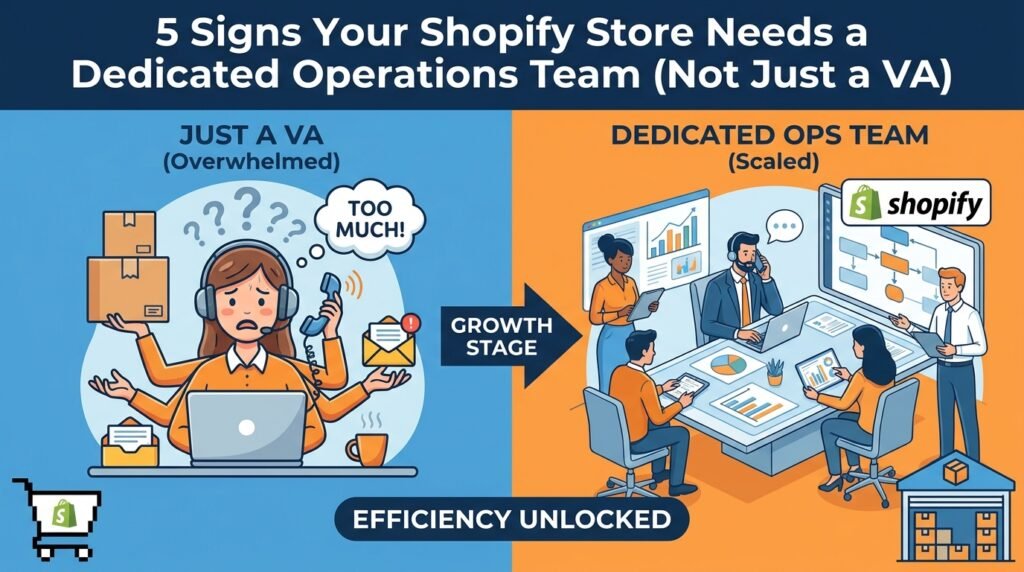
Hiring a virtual assistant feels like the obvious first move when a Shopify store starts outgrowing one person. It’s cheap, it’s fast to set up, and it takes some tasks off your plate. For a while, it works.
Then the cracks show up. Tickets pile up because your VA can only handle straightforward questions. Fulfillment issues slip through because no one’s actually watching supplier timelines. Returns sit unprocessed because the person handling them also handles five other unrelated tasks and none of them get done well.
A VA is built to complete tasks. An operations team is built to run a system. The difference matters a lot more than most store owners realize — and it usually only becomes obvious after growth has already started slipping through the cracks.
Here are five signs that your store has outgrown the VA model and needs something more structured.
Sign #1: Your Response Times Are Quietly Getting Worse
In the early days, a single VA can keep up with a trickle of customer emails. But as order volume climbs, response time creep is one of the first warning signs that operations have outpaced your support setup.
Here’s the problem: this decline is rarely dramatic. It’s not a sudden flood of complaints — it’s a slow drift from “under 2 hours” to “half a day” to “sometime tomorrow, maybe.” By the time you notice it in your help desk metrics, you’ve likely already lost customers who didn’t bother waiting for a reply and simply refunded through their card provider instead.
Industry benchmarks generally put acceptable ecommerce response times under 4 hours for email and under a few minutes for live chat. If you’re regularly missing that — and it’s not a one-off busy week — a single VA juggling support alongside other tasks is usually the bottleneck, not a lack of effort.
A dedicated operations team solves this structurally: multiple people covering support means no single person’s bandwidth caps your response time, and no single person’s day off turns into a 24-hour delay.
Sign #2: Fulfillment Problems Reach You Before They Reach Your Team
This is one of the clearest signals of an operations gap. If you’re the one finding out a supplier shipment is delayed — because a customer emailed you directly, or you happened to check tracking numbers yourself — your operations setup isn’t actually catching problems. It’s just relaying them.
A VA handling fulfillment usually works reactively: they respond to what’s already gone wrong. A dedicated operations team works proactively — tracking shipments, flagging delays before customers notice, and coordinating directly with suppliers to resolve issues before they become complaints.
This distinction compounds especially fast for dropshipping and China-sourced stores, where supplier communication and logistics timing require actual relationships and experience — not just someone checking a tracking page once a day.
This is the exact gap our team is built to close. EcomDeskPro’s operations specialists don’t just respond to fulfillment issues — they catch them early through direct supplier relationships and proactive tracking, so problems get solved before your customers ever have to ask. If shipment delays keep landing in your inbox first, a free strategy call is a good place to see what proactive fulfillment management actually looks like.
Sign #3: You’ve Started Avoiding Your Own Return Policy
Returns and refunds are one of the most operationally taxing parts of running a store — and one of the first areas that quietly gets neglected when a single VA is stretched thin. If you’ve noticed your team approving refunds just to make a ticket go away, rather than following your actual policy, that’s a sign the return process has stopped being managed and started being survived.
Left unaddressed, this has real financial consequences. Inconsistent return handling doesn’t just cost you margin on individual refunds — it teaches customers (and sometimes fraudulent actors) that your policy is negotiable if they push hard enough or escalate loudly enough.
A dedicated operations team treats returns as a defined workflow: consistent policy enforcement, clear documentation for exceptions, and a paper trail that protects your margins while still treating customers fairly. That consistency is difficult to maintain when returns are just one more item on a generalist’s overflowing task list.
Sign #4: Your Store Management Tasks Are Falling Behind
Beyond customer-facing work, every Shopify store has a layer of ongoing maintenance: inventory syncing, listing updates, correcting pricing errors, managing out-of-stock products, updating shipping settings during promotions. These tasks aren’t urgent individually, which is exactly why they’re the first things to slip when a VA is overloaded.
The problem is that “not urgent individually” adds up. Outdated inventory counts lead to overselling. Unoptimized listings quietly underperform in search and on-site conversion. Promotional pricing that doesn’t get reverted on time eats into margins for days before anyone notices.
A single generalist VA, juggling support tickets and fulfillment and these maintenance tasks all at once, will naturally prioritize whatever’s most urgent that day — which means the important-but-not-urgent store management work gets pushed indefinitely. A dedicated team with defined roles keeps this maintenance layer running consistently, instead of it becoming the thing that only gets attention when something breaks.
We see this pattern constantly with growing stores — not a lack of effort, just too many roles stacked onto one person. EcomDeskPro’s specialist structure means store management, fulfillment, and support each get dedicated attention instead of competing for the same person’s hours. Book a 30-minute strategy call and we’ll walk through exactly what’s falling through the cracks in your current setup.
Sign #5: You’re the Backup Plan
Perhaps the clearest sign of all: when your VA is out sick, on vacation, or simply overwhelmed, who handles operations? For most stores relying on a single VA, the honest answer is “the founder, eventually.” That’s not a resilient system — it’s a single point of failure with your name on it.
A dedicated operations team is built around redundancy. Multiple specialists cover different functions, which means one person’s absence doesn’t mean tickets go unanswered or shipments go untracked. It also means institutional knowledge — your policies, your customer history, your supplier relationships — doesn’t live in one person’s head, vulnerable to turnover or burnout.
If your business can’t function normally for a week without you personally stepping back in, your operations aren’t actually outsourced. They’re borrowed.
The Real Difference: Tasks vs. Systems
A VA is hired to complete tasks you assign. A dedicated operations team is built to run a system — with defined processes, escalation paths, reporting, and redundancy that doesn’t collapse the moment volume increases or one person is unavailable.
Neither approach is “wrong” — a VA can be a perfectly good starting point for a small store handling low order volume. But the five signs above are the signal that your store has crossed a threshold where task-based help isn’t enough anymore. What you need at that point isn’t more hours from the same VA. It’s a structured team built specifically around ecommerce operations.
What This Actually Looks Like in Practice
Making the shift from a VA to a dedicated operations team doesn’t have to mean an overwhelming overhaul. The stores that transition smoothly usually do it in stages: documenting existing processes, transferring high-volume repetitive tasks first (order status, tracking inquiries, standard returns), and building in reporting so visibility actually improves rather than disappears.
The result isn’t losing touch with your business — it’s the opposite. Founders who make this shift consistently report knowing more about what’s happening in their store, not less, because they’re finally getting structured reports instead of scattered fire-fighting updates from an overloaded VA.
Bringing It All Together
If you’re seeing response times creep up, fulfillment problems reaching you before your team, returns handled inconsistently, maintenance tasks slipping, or you’re still the de facto backup for everything — these aren’t isolated problems. They’re symptoms of the same root cause: task-based help stretched past its capacity.
Recognizing the signs early means you can make the shift on your own timeline, rather than after a bad week (or a bad review) forces the issue.
If more than one of these signs sounded familiar, that’s usually the moment to make the switch. EcomDeskPro is a specialist Shopify operations team — not a single generalist VA — built specifically to handle fulfillment, support, and returns as a coordinated system, with the reporting to keep you fully informed. Talk to us on a free strategy call and we’ll help you figure out exactly where your current setup is stretched thin.