
Every dropshipper has the same origin story: they find a product that seems perfect, launch ads, and wait. Sometimes it works. More often, it doesn’t — not because the marketing was bad, but because the product was never actually validated in the first place.
The dropshipping market itself isn’t the problem. Global dropshipping sales are estimated to have crossed $290 billion in 2025, with continued rapid growth projected over the next decade — there’s no shortage of demand or opportunity out there. The problem is that most sellers still pick products based on gut feeling instead of data, and gut feeling doesn’t scale.
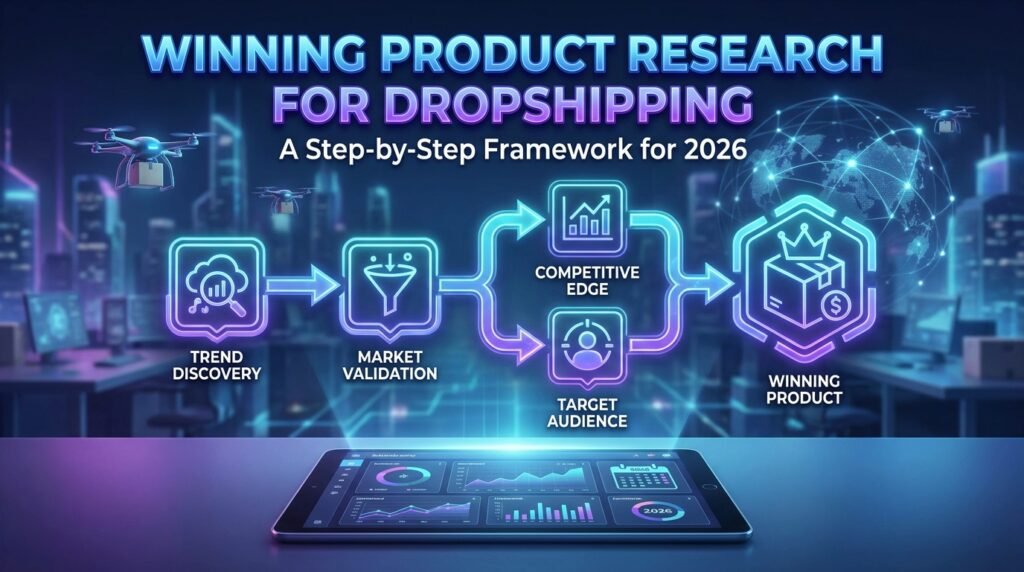
In 2026, product research isn’t about finding something “cool” on TikTok and hoping it converts. It’s a repeatable process — one that separates sellers who build sustainable stores from sellers who burn ad budget testing products nobody actually wants. Here’s the framework.
Step 1: Understand What “Winning” Actually Means in 2026
Before searching for products, it helps to define what you’re actually looking for. A winning dropshipping product in 2026 typically has a few things in common:
- It solves a specific, felt problem — not a vague “nice to have,” but something the buyer notices themselves needing
- It’s visually demonstrable — products that show their value in a 15-second video consistently outperform products that require explanation
- It has healthy margin room — products in the roughly $30–$80 price range tend to perform well for impulse-driven ecommerce purchases while still leaving enough margin to cover ad spend and fulfillment costs
- It isn’t already oversaturated — trending doesn’t always mean available; some products get discovered by hundreds of stores within weeks of going viral
Keeping these filters in mind before you start browsing prevents the most common trap: falling in love with a product because it’s interesting, rather than because it’s provable.
Step 2: Source Ideas From Multiple Discovery Channels
No single platform reliably surfaces every winning product, so effective research pulls from several sources at once:
- Social commerce signals — TikTok’s Creative Center and ad libraries reveal which product videos are actively gaining traction, along with real engagement data rather than guesswork
- Competitor store analysis — tools that scan live Shopify stores can reveal what competitors are actively selling and testing, often before a product fully trends
- Marketplace bestseller data — Amazon Movers & Shakers and similar bestseller lists show real, ongoing purchase behavior rather than just impressions or likes
- Supplier platforms directly — the AliExpress Dropshipping Center and similar supplier-side tools surface order volume and growth trends straight from the source
The goal at this stage isn’t to pick a winner yet — it’s to build a shortlist of 15–20 candidate products worth validating further.
Step 3: Validate Demand With Real Data, Not Vibes
This is the step most beginner dropshippers skip, and it’s the single biggest reason products fail after launch. A product “looking” popular in an Instagram ad or a TikTok video is not the same as having validated demand.
Dedicated product research tools exist specifically to close this gap. Platforms like Minea and Sell The Trend track ad longevity and engagement across active campaigns, while tools like ZIK Analytics and Dropship.io pull real sales data from live Shopify stores and marketplaces. Directories like EcomHunt curate and cross-check trending products against historical performance data, rather than surfacing anything simply because it’s new.
When validating a product, look for signals like:
- Ad longevity — a product with ads running consistently for multiple weeks (not days) usually indicates real, sustained performance, not a one-off viral spike
- Multiple sellers testing simultaneously — competitor momentum is a positive signal, not automatically a red flag; it confirms the market is actively spending money to acquire customers for this product
- Review velocity on marketplaces — a steady, growing stream of reviews signals repeat, real purchases rather than a short-lived trend
This is exactly the research work our Growth & Marketing team handles for clients every week. Instead of guessing which products might work, EcomDeskPro validates demand using real ad and sales data before you spend a dollar on testing. If picking your next product feels like a gamble right now, a free strategy call is the fastest way to see how a structured research process changes that.
Step 4: Check for Saturation Before You Commit
A product can be genuinely in-demand and still be a poor choice if the market is already flooded with sellers offering it at razor-thin margins. Saturation checks should happen before, not after, you commit ad budget.
Practical ways to check saturation:
- Search the product name plus “dropshipping” or “review” and see how many active stores and ad variations already exist
- Check how differentiated the available creative angles are — if every competitor is running the exact same video with the same hook, the easy wins have likely already been captured
- Look at pricing spread across competitors; if margins have already been squeezed to the bottom through price competition, there may not be enough room left to profitably enter
Products in the early growth phase of a trend — where competition exists but hasn’t yet flooded the market — generally offer the best entry window. Waiting until a product is fully mainstream usually means competing purely on price.
Step 5: Vet Suppliers Before You Vet Creative
It’s tempting to jump straight from “found a promising product” to building ad creative. But supplier reliability determines whether that product can actually sustain a business, and it deserves real scrutiny before launch:
- Shipping timelines — anything consistently over 10–15 days significantly increases refund requests and chargebacks, regardless of how good the product is
- Order volume history — suppliers with a longer track record of fulfilled orders tend to be more reliable than newly listed ones
- Product quality consistency — checking recent buyer reviews and photos (not just the supplier’s own listing images) helps catch quality issues before they become a wave of returns
Skipping this step is one of the most common reasons a product that looked “winning” in research turns into a return-and-refund nightmare in practice.
Supplier vetting is where a lot of independent dropshippers get stuck — it’s time-consuming and easy to get wrong without established relationships. Our team works from eight years of direct supplier connections in China, which means product research doesn’t stop at “is there demand” — it extends to “can this actually be fulfilled reliably.” Book a strategy call if supplier vetting has been the missing piece in your product testing process.
Step 6: Calculate Real Margins Before Testing
Before launching any product test, run the actual numbers — not estimates. A general rule of thumb in dropshipping is pricing at roughly three times your product cost to leave enough margin for advertising spend, platform fees, and returns. If a product can’t comfortably support that multiple given realistic ad costs in its category, it’s not ready to test yet, regardless of how strong the demand signals look.
This step catches a specific and common mistake: chasing a trending product that technically sells, but whose margins are too thin to survive normal ad costs and return rates once you’re actually running it at scale.
Step 7: Test Small, Then Scale What Works
Even with strong validation data, no product is confirmed until it’s tested with real ad spend and real customers. The most reliable approach is testing a batch of 5–10 shortlisted products with modest ad budgets, rather than betting heavily on a single “sure thing.”
This batch-testing approach does two things: it protects you from a single bad prediction wiping out your budget, and it gives you comparative data — sometimes a product that looked mediocre on paper outperforms your top pick once real customers respond to it. Let the data from actual testing, not the research phase alone, make the final call on what gets scaled.
Bringing It All Together
Winning product research in 2026 isn’t about finding the next viral TikTok item before anyone else does — it’s about building a repeatable process that filters out guesswork at every stage: demand validation, saturation checks, supplier reliability, and real margin math. Sellers who treat this as a system consistently outperform sellers who treat it as luck.
The tools and data to do this well exist and are more accessible than ever. What most stores are actually missing isn’t access — it’s the time and process discipline to do it consistently, week after week, on top of everything else running a store requires.
If product research keeps getting pushed to “whenever I have time,” that’s usually the sign it needs a dedicated process, not more hours in your week. EcomDeskPro’s Growth & Marketing team handles winning product research as a core service — combining real sales data, supplier vetting, and margin analysis so you’re testing with confidence instead of guessing. Get in touch for a free 30-minute strategy call and let’s talk about what a structured research process could do for your next launch.